
By Daniella Staios, Mars United Commerce
In the age of hyper-competition, Canadian retailers are finding themselves at a crossroads: adapt to rapidly advancing technology or risk falling behind. This crossroads has many retailers exploring a new innovation: smart shelving, a technology-driven approach to the in-store experience that is transforming how products are displayed, priced, and managed for Canadian shoppers.
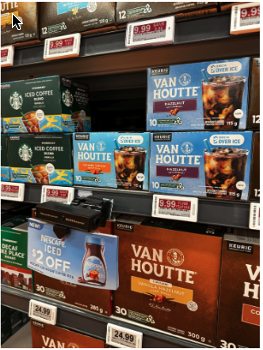
The Rise of Technology at Retail
The retail landscape in Canada has undergone significant changes in recent years, largely sparked by the COVID-19 pandemic in 2020. With online shopping evolving rapidly to become not only more accessible, but also faster and more normalized, Canadian consumers now expect a similar level of convenience when shopping in-store.
In fact, 67% of Canadian consumers now expect retailers to deliver an integrated experience between their online and in-store channels, with a growing number demanding personalized services and real-time information, according to Arcus Consulting Group. In an already highly competitive market, Canadian retailers are left with no choice but to evolve to maintain relevance among consumers.
Smart Shelving: Finding Your Niche
To meet these rising consumer expectations, Canadian retailers are exploring smart shelving systems embedded with radio frequency identification (RFID) tags, and digital displays that collect real-time data on shopper behaviour and how products at shelf are performing.
Smart shelving originated in Europe in the early 1990s as simple electronic shelf labels (ESLs) that could replace paper tags and reduce the heavy labour requirements associated with keeping prices up to date. The technology has evolved dramatically over the years through the introduction of AI, and on a global scale has gained adoption across Europe, Asia‑Pacific, and North America, according to ABI Research.
While smart shelving may be in its early stages in Canada, adoption is quickly accelerating. The Canadian market for electronic shelf labels (ESLs), was valued at roughly $83 million in 2024 but is expected to reach $344 million by 2033, according to Grand View Research projections. Mordor Intelligence also anticipates Canada to be “the fastest-growing market in North America,” with projected growth of 24% from 2024 to 2029.
Some retailers are already taking smart shelving mainstream. Loblaws, for instance, deploys roughly 10 million ESL tags annually across its nearly 2,800 grocery stores. These digital labels do a lot of heavy lifting: automatically updating prices, syncing with point-of-sale systems, and cutting down on both paper and labour costs.
Sobeys is taking a similar approach, with plans to roll out five million ESLs across its stores by 2026 after staging successful initial pilots. Walmart has even integrated a system that that uses cameras to monitor shelf inventory levels and triggers real-time replenishment alerts when items go out of stock or run low, according to Grocery Business.
These technologies give retailers a significant level of insight into shopping behaviour that was once only possible online. That moment of hesitation when a shopper picks up a bag of chips, thinks twice, and puts it back? Smart shelves capture it. Sensors and shelf-level analytics reveal which products get noticed but not purchased, how often items are handled, and how foot-traffic patterns shift throughout the day. With this data, retailers can rethink shelf layouts, update promotional placement, and even adjust the timing of pricing to create a shopping experience that responds directly to real-time shopper behaviour.

Potential Implications & Opportunities
Like most innovation, smart shelving isn’t a one-size-fits-all solution. While it offers powerful tools for understanding shopper behaviour, integrating this technology into existing store environments can be a challenge — especially for small or independent retailers who may not have the resources and infrastructure needed for implementation.
At the same time, while tracking shopper behaviour at the shelf is becoming more important than ever, it raises some important questions: Are customers aware that they’re being monitored when they walk into the store, and will they be comfortable with it? Retailers need to ensure they’re complying with all privacy regulations and being fully transparent with their shoppers.
Smart shelving is more than just a tech upgrade; it’s a way for retailers to better serve and understand their shoppers. By tracking how shoppers interact with products in real time, retailers gain valuable insights that lead to smarter decisions about inventory, pricing, and promotions. For the shopper, this can mean more relevant offers, better-stocked shelves, and a more personalized in-store experience.
It’s a game-changer for brand marketers as well. Instead of relying solely on sales data, they can now see what actually influences buying decisions at the shelf and even undertake real-time A/B testing to experiment with various pricing and visual cues. These insights fuel sharper, more targeted campaigns grounded in how consumers actually shop, not just what they end up buying.
Smart shelving isn’t perfect, of course. Smaller retailers may face integration barriers, and questions around data privacy still need to be addressed. Yet, when used thoughtfully, it has the potential to benefit shoppers, retailers, and brands by creating a more connected, relevant in-store environment.
About the Author

Daniella Staios is an Account Executive, Client Leadership at Mars United Commerce, where she supports two key books of business. She’s passionate about building genuine relationships with clients and takes a shopper-first approach that is grounded in insights-driven strategy and a clear focus on how shoppers think, behave, and buy.
In-store photos courtesy of Path to Purchase Institute.