
The 15th edition of the industry’s most informative cross-network assessment guide evaluates 89 capabilities at 27 leading platforms.
To download the report, fill out the form below.
What a difference a quarter makes. As we published the last edition of our Retail Media Report Card back in June, some industry pundits were speculating that the rise of the agentic search would have a negative impact on the future relevance of retail media networks.
Fast-forward a few months, and networks not only are forging partnerships with leading third-party answer engine operators but introducing agentic search platforms of their own — complete with incremental ad inventory for brand partners (see page 9 for a few examples).
Networks also continue to diversify their media inventory well beyond the onsite ad opportunities that currently still account for 77% of U.S. outlays, per EMARKETER.
They’re building in-store media platforms to reach the millions of shoppers who still make most CPG purchases. And they’re spreading out across all avenues of offsite digital media to reach existing and new shoppers anywhere they consume media. Heck, they’re even starting to create the content that’s being consumed (see page 24).
Collectively, these measures counteract the potential impact of agentic search, which theoretically reduces traffic to retailer websites by helping shoppers make decisions beforehand. Initial crisis averted.
Retail media therefore heads into the back half of 2026 with wind in its sails and momentum in its sales: EMARKETER projects U.S. ad spending to grow another 20% (or so) to reach nearly $73.0 billion this year and hit $118 billion by 2030. And while most of that will still go to onsite activation, offsite media allocations (including in-store) are growing twice as fast. That bullishness has some retailers openly discussing their retail media revenue as part of earnings calls as a vital source of overall growth.
The amplified marketplace competition brought by agentic search, meanwhile, is helping drive ingenuity and innovation, as networks strive to build unique platforms and processes that make it easier for brand partners to achieve their specific business goals by providing access to identified audiences across the entire path to purchase.
Intensifying competition is also making it even more critical for brand advertisers to scrutinize their retail media options carefully. Brands are tasked with developing a strategic understanding of how best to leverage retail media to drive incremental growth, deciding which retailers provide the greatest opportunities for success, and determining what specific media tactics are most effective at achieving the desired impact.
They also must align their retail media activity with the rest of the commerce marketing plan, which can improve success not only through more seamless shopper engagement but by fostering greater internal efficiency across functions. This step is critical to future growth for brands and the retail media networks themselves.
On the other side of the table, retail media networks similarly understand that future sales growth will require a greater emphasis on enterprise-wide commerce partnerships rather than a myopic focus on media transactions. Integration has become a cornerstone for success.
New Features This Quarter
We update each quarterly Report Card to reflect the ongoing enhancements made by these platforms, to evaluate additional platforms, and to modify our analysis as needed to continue reflecting best practices in the industry.
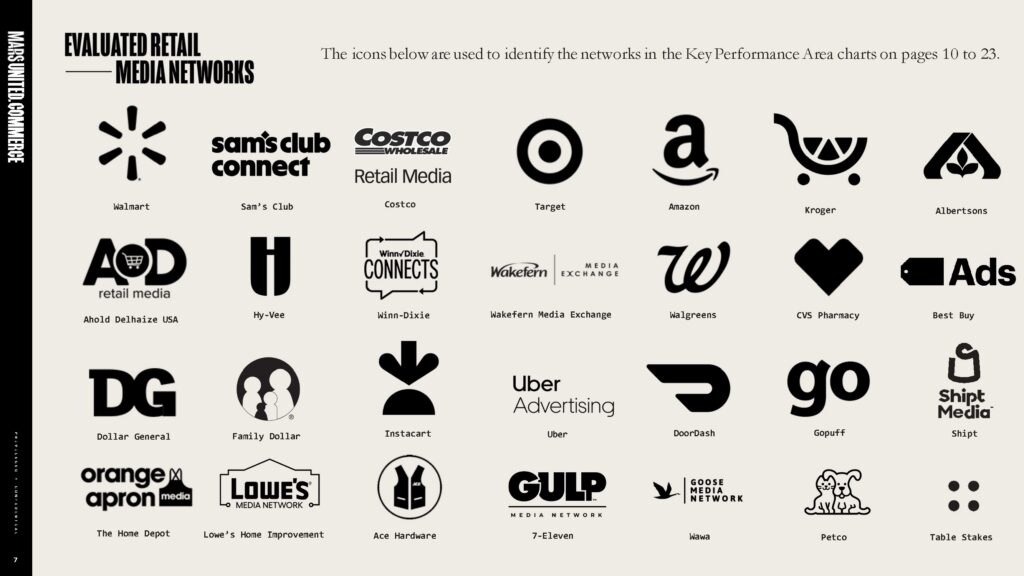 For that reason, we updated our Platform Profiles last quarter to more clearly and explicitly present each network’s key capabilities and ways of working. See page 27 for a rundown of all the new elements.
In terms of capability updates, 16 of the 27 retail media networks covered in this Report Card added a collective 47 tools and opportunities to their existing capabilities, working either to keep pace or gain an advantage (as the case may be) in this highly competitive marketplace.
Lowe’s Media Network outpaced the field with eight updates across four Key Performance Areas, followed by Uber Advertising with six. Ace Hardware’s RedVest Media and Shipt Media had five updates apiece.
The totals represent more updates among fewer networks than in the second-quarter Report Card, a possible sign that some of the more established networks are reaching maturity in terms of their basic capabilities and are now doubling back to develop more sophisticated tools.
Updates for Targeting and Measurement & Reporting Capabilities were the most common this quarter, a trend even more evident in the drill-downs for those two Key Performance Areas now presented in the Platform Profiles.
It’s also worth noting that 40% (19) of the updates came from on-demand delivery providers Uber, Shipt, DoorDash, Instacart, and Gopuff. The channel has become an important part of retail media strategy for brands looking to reach shoppers in retailer-neutral environments.
We hope you enjoy the 15th edition of Mars United’s Retail Media Report Card.