
By Amanda Wineland, Mars United Commerce
Some think automation is the magic solution for all marketing. Some think automation is the death of emotional engagement. What if they’re both right and wrong?
I have been in the shopper marketing space for more than 20 years now. One thing I’ve learned to count on? Disruption. From the introduction of online shopping in the 1990s to omnichannel integration and social commerce in the 2010s, how we shop changes and it always will.

But I also know that human motivation and psychology change very little. At our core as humans, we have needs and desires to fulfill. We have self-perceptions to reinforce and cognitive biases we can’t shake. It is only how we approach these things that changes.
It is tempting as a marketer to go all in on automation and efficiency. Cost savings and speed to results matter. The idea that we can push a button and see the returns come rolling in is tempting. Skip the “soft” stuff and get right to the sale.
But for years, we have wrestled with a perceived trade-off: automation versus emotional engagement. The assumption? If we lean into the AI-driven shopping experience, we sacrifice the human nuances that make shopping meaningful. But that’s a false choice.
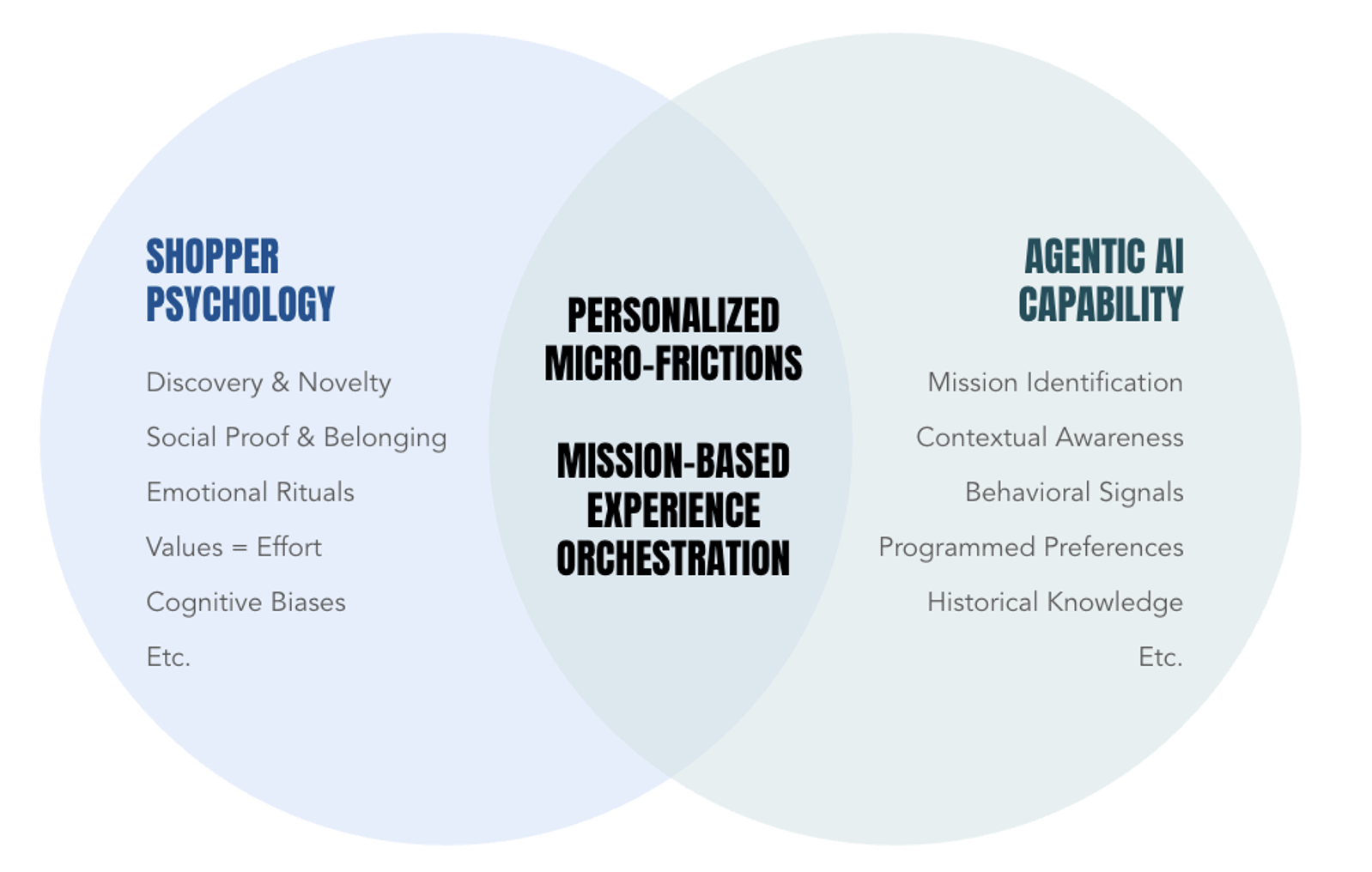
AI-powered shopping is the next evolution of commerce technology. But it doesn’t need to exist simply to remove friction. Because here’s the hot take: shoppers don’t actually want a totally frictionless experience. AI has the power to adapt dynamically to shopper missions and emotional signals, creating experiences that feel both effortless and deeply personal, injecting the right kind of friction. The key is understanding that shopper psychology and AI aren’t competitors—they’re collaborators.
Why Shopper Psychology Still Matters
No decision-making, including shopping, is purely rational. It’s influenced by identity, emotion, and cognitive biases.
People seek discovery and novelty (dopamine triggers)
They need social proof and belonging (evolutionary risk reduction)
They engage in emotional rituals (gifting, celebration, nesting)
Their effort signals their values (investing in what matters)
Automation often strips these away in the name of efficiency. That’s where strategy comes in.
Agentic AI: Adaptive, Not Mechanical
Agentic AI acts autonomously, guided by shopper-centric goals, adjusting in real time based on:
Mission: Is this a quick replenishment or an exploratory browse?
Context: What are the time pressures, channel factors, and emotional cues?
Behavioral Signals: What do we know about hesitation, dwell time, tone of voice?
Instead of flattening the experience, AI can design the right friction at the right time, layering micro-frictions like curated recommendations, comparative analysis, deeper exploration, or gamified discovery when engagement matters.
How Agentic AI Enhances Shopper Psychology
Mission-Based Design: Speed for routine tasks, depth for exploration, curation for solutions.
Personalized Micro-Frictions: Gamified discovery for novelty-seekers, social proof for risk-averse shoppers, comparisons for the price-conscious.
Emotional Intelligence Layer: Detect stress? Simplify. Detect curiosity? Enrich. Detect impatience? Guide.
Example: A gifting mission triggers immersive content, social proof, and premium packaging options even in a frictionless digital flow. Meanwhile, a stock-up mission triggers simplified replenishment paired with interactive solutions in categories of interest.
The Model for Harmony
Efficiency satisfies functional needs. Engagement satisfies emotional needs. Agentic AI can make mission-first design scalable, blending frictionless speed with friction-right enjoyment.
Why Harmony Requires Strategy
Automation can execute flawlessly, but it needs human-led intent. Planners can outline:
Shopper Missions: AI can adapt only if the mission frameworks exist.
Guardrails: Tone-deaf automation can be prevented and brand equity protected.
Behavioral Blueprints: Shopper psychology (identity, rituals, cultural context) requires interpretation beyond data.
Balance: Storytelling and sensory cues must be layered in so automation doesn’t overly flatten the experience.
Bottom Line: Technology scales execution. Strategy scales meaning. Brands that lean into strategic commerce marketing will ensure that automation serves the brand, the retailer, and the shopper.
In the end, disruption will never cease. And that’s a wonderful thing. Human ingenuity and drive will continue to deliver the next best thing to our industry. It is our role as marketers to think critically, consider broadly, and act with humanity.
Disclaimer: This article was drafted with the assistance of Microsoft 365 Copilot to enhance clarity and structure. All the ideas, insights, and connections presented, however, are entirely my own and reflect my personal perspective and expertise.
About the Author

Amanda Wineland is SVP-Strategic Planning at Mars United Commerce. While her roots are in psychology, she has now spent more than 20 years applying the unique perspectives of that discipline to the insights and strategic planning space, working across retailers and industries from mass to convenience and beauty to mobile. Wineland finds the influential insights that drive sustainable human behavior while leading a team of strategists for Mars United’s leading clients through the latest data technology paired with the smartest humanity.