
Agentic commerce might seem intimidating. But it could lead to a deeper, more informed understanding of shoppers.
By Amy Andrews, Mars United Commerce
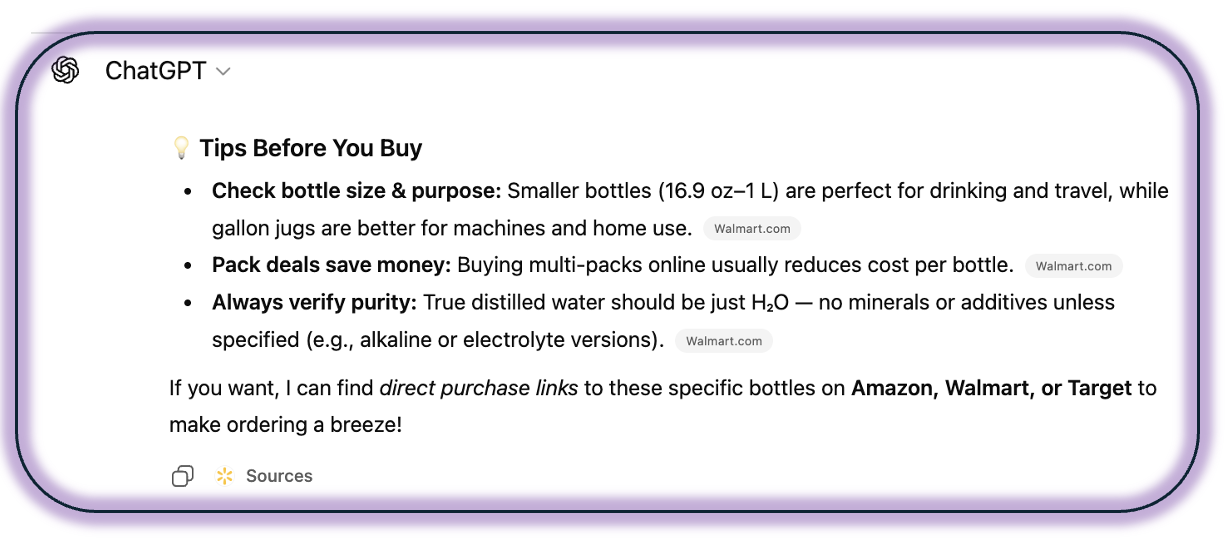
On a business trip to Las Vegas last month, I asked ChatGPT what I should do for my skin in the dry climate. The answer I got wasn’t just a recommendation for skincare, but a total health solution: I should get more sleep, and I should drink more water. And since ChatGPT knows that I’ve purchased distilled water in the past, it offered to buy me some and have it delivered to my hotel room.
We’ve been talking for quite some time now about the purchase funnel collapsing, and here’s the evidence. We used to talk about bringing consumers all the way through the funnel, and now the entire journey can happen in a matter of seconds based on an agentic search engine’s knowledge of my past prompts and past purchases. The process is becoming more relevant — not to mention more intimate.
Agentic commerce might be a new game for the industry, but the old rules of shopper engagement still apply. Mars United has always worked to help clients win across every shelf; until recently, that entailed the physical, digital, and social environments. The goal has been to deliver the best benefits to shoppers at each shelf. And in that context, the agentic shelf isn’t really different.
We often talk about influencing consumers by giving them “RTBs.” Through national media, that’s giving them a “Reason to Believe” in the brand. When we get into the shopper space, it’s a more direct “Reason to Buy” at that moment. Now, with agentic search, we need to present a “Reason to Belong” in the conversation — and not just the current conversation between shopper and agent, but all the prior conversations about the brand that are feeding the recommendations.
This requires some new ways of thinking. As marketers, we’re always trying to be concise. On a product detail page, for instance, we look for that short piece of content, that perfect word or perfect image, that’s going to drive conversion in three seconds or less.
With agentic commerce, we almost need the opposite strategy to feed the agents as much information as possible. We can upload an entire text-based user manual — the shopper doesn’t have time to read all that, but the agent does. Rather than scaling back on content, we now need to continuously feed the agents with more content — on product detail pages and anywhere else they gather their information. (ChatGPT currently sources 40% of its content from Reddit; do you have a Reddit commerce strategy yet?)
But that final conversation between shopper and agent requires personalization. We have to take all that content and tailor it for the different conversations consumers are having. Thanks to AI, there’s so much exciting content we can create to ensure we’re delivering a hyper-relevant, intimate conversation to each individual shopper.
A lot of this is uncharted territory, and everything is moving quickly. Shoppers are moving faster than we are right now, and we have to find ways of keeping up. Part of the new way of thinking I mentioned is a willingness to fail fast. Brands, retailers, and their agencies have to be comfortable trying new things together. Partnerships — maybe even with “friendly foes” on occasion — are going to be critical to move forward.
This is a fascinating learning playground. One of the most exciting aspects for me is the ability to know our shoppers better than ever before — at a different, deeper individual identity level. ChatGPT is already getting 52 million shopping-related queries each day. All that information won’t just feed the marketing and messaging we create for agentic platforms, but the total experiences we bring to our shoppers across every shelf. That makes it a very exciting time to be in the commerce space.
At the moment, we’re still defaulting to the concept of shoppers directing these agents to make a purchase (or still doing the buying themselves). The future becomes even more interesting when you consider a true agentic purchase — where the agent already knows this particular shopper would be interested in trying a new flavor of her favorite distilled water and simply orders it for them.
And maybe the agent also makes sure my favorite distilled water is waiting for me in the hotel room before I even have to ask. And the only thing I’ll need to do is be surprised and delighted when I get there.
About the Author

As President of Mars United Commerce, Amy Andrews leads the commerce marketing company’s strategy and operations in North America. She has spent her 20-year marketing career focused on understanding how shoppers shop and creating engaging commerce experiences on both the agency and client side, including leading the shopper marketing & insights team at Ubisoft Entertainment.
In her nearly 15 years of tenure at Mars United, she has co-founded an in-house strategic consultancy, launched the first international office in London, and opened the company’s first Seattle office to service Mars’ clients’ growing Amazon business. Most recently, she served as Chief Business Strategy Officer, overseeing activity for all North American brand clients. Amy became President when Mars United Commerce was acquired by The Publicis Groupe in 2024.