
Mars United spoke with longtime client, partner and colleague Stephen Chriss, VP of Enterprise Omni-Commerce at The Campbell’s Company, on the eve of his induction into the Path to Purchase Institute Hall of Fame last November. Chriss discussed the evolution of the commerce marketing industry and the changes he has experienced as a practitioner over the last 35 years.
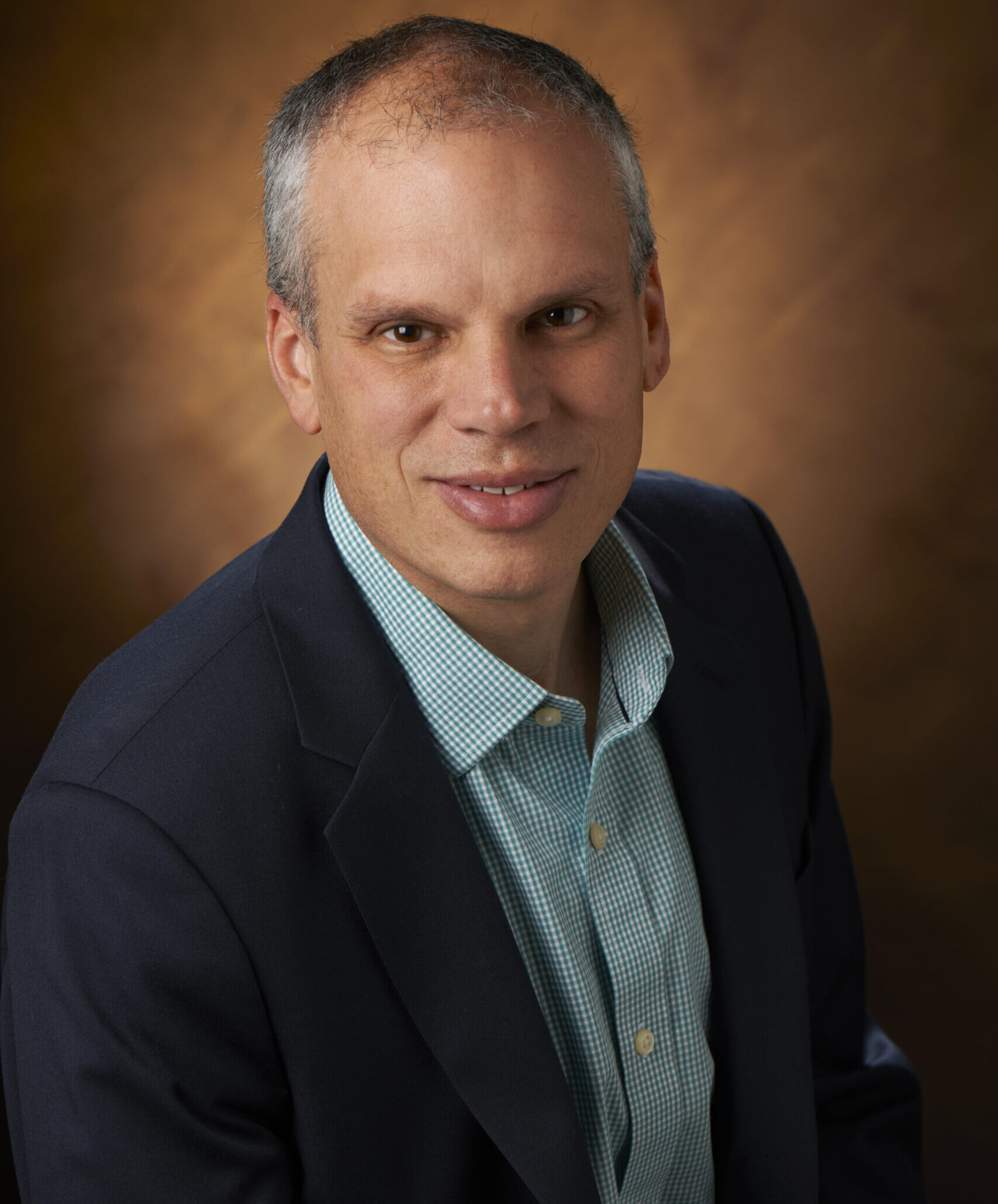
You’ve had an accomplished career journey spanning roles at several leading CPGs, and now with The Campbell’s Company for the last five years. From your vantage point, how would you describe the current state of commerce?
Chriss: The words that come to me first are controlled chaos.
The shopper is more in control than ever before, and that’s primarily tech-enabled. That has been the evolution of the industry for probably the last 20 years or so, and COVID just accelerated that. Things are moving really, really fast now.
One could argue that it’s complete chaos, but I think there’s control to it. There are more parameters, and really smart people, agencies, manufacturing partners, and retailers that are keeping it all within guardrails — but within those guardrails, it’s chaotic.
How do you navigate controlled chaos?
Chriss: There are two things that come to mind immediately. The first one is: Where do you need to lean in and lead the way? Connected to that is the second one, which might be more important to me — and that is: Where do you fast follow?
From a commerce perspective, there are fundamentals in my world that require you to lean in. The digital shelf has to be AI-ready — you can’t fast follow there. We need to make sure that we’re AI-ready with everything and anything as we show up in the digital space however, and whenever, the shopper wants — whether they’re using traditional search or they’re using AI.
But there are some other areas — which can be complex, expensive, scary — where you need to pause and understand whether you should be a fast follower. Am I going to get hurt by not leading the way, or can I quickly catch up to my competitors or peers after observing where they’re winning and failing?
From a talent perspective, the key is to embrace change, not get paralyzed about AI replacing us all, and understanding our new roles in the AI world.
Over the course of your career, how has the industry changed for the better?
Chriss: For the most part, what I’ve seen over my 35 years is that, if you keep the shopper or the consumer at the center, making it seamless (not to use a cliche) and easy for them to navigate commerce, then the industry’s evolution can always be for the better.
For us as practitioners, though, it has absolutely become more complex. But shoppers are more complex as well, and that’s part of the technology evolution and the amount of information that is inundating them in their daily lives.
I have a glass-half-full perspective on that. The amount I’ve learned in the past couple of years, compared to my first 30, is night and day. That technology and innovation, paired with the goal of keeping it simple for shoppers and making their lives easier, also brings personal growth across all aspects: myself, agencies, retailers, and other partners are all getting smarter along with shoppers.
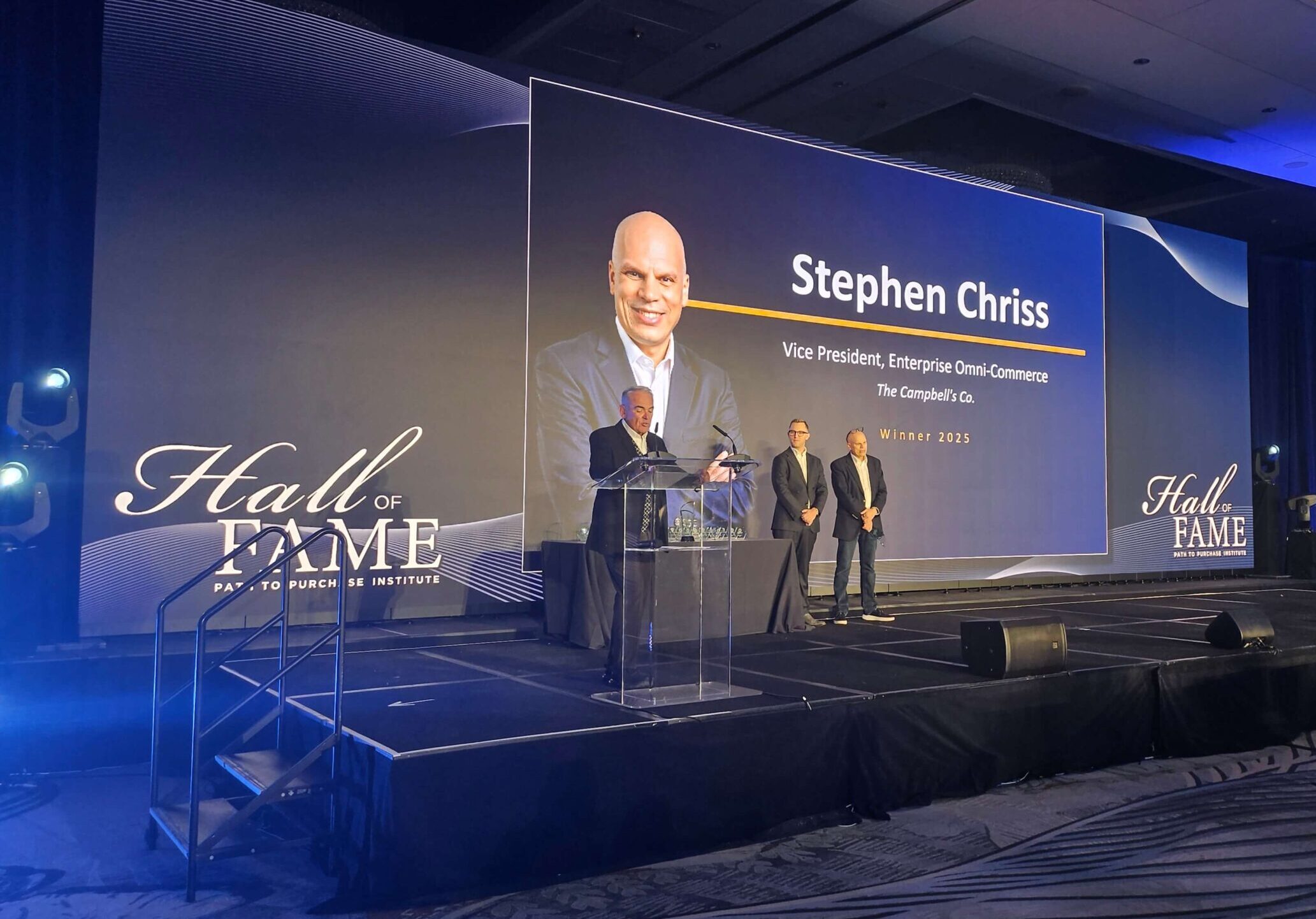
Chriss on stage at P2PI Live last November to receive his Hall of Fame award.
Has anything changed for the worse?
Chriss: I don’t want to suggest everything is rainbows and unicorns. The watchout is this: Is it all getting too smart, too fast, too complicated? Are we losing control?
If you overuse technology and insights, then complexity and automation begin to creep in while human nature begins to get lost. Those are areas where I’m a bit concerned about the evolution being for the worse.
The macro environment also has an impact on us. There’s volatility in the political climate and the economy. There are a lot of unknowns. The amount of money in our pocketbooks for shopping, from impulse to planned, is worse today than it has been over my many years.
The other thing on the human side that I’m very aware of when it comes to my own team is that people are working harder now than they did in the past. It’s funny, because technology is supposed to be an enabler. Yet, I think we’re working people harder than they’ve ever been worked before and potentially leading to burnout. There are talent and culture challenges throughout the industry.
It coincides with the time we’re in: Do more with less, because tech and AI are supposed to make things that once took an hour get down to one minute. But tech might not be where we need it to be to make things easier for all the people doing the work.
We need to stay aware of this combination of people, talent, culture, the macro environment, and the dangers of tech and automation versus human strengths.
Finally, what has stayed the same during your career?
Chriss: We’re just scratching the surface of some complex topics here, but the thing that has stayed the same is the shopper’s core needs. Nothing changes there: they have to be at the center. Taking a shopper-first approach begins by understanding who’s buying your products and how to engage them. Campbell’s’ mission is about connecting people through food they love, and that hasn’t changed.
What has changed is the toolbox, which has gotten much more complex. There are fancier tools to reach shoppers — but they’re still us. We’re still shoppers and our core needs haven’t changed all that much.
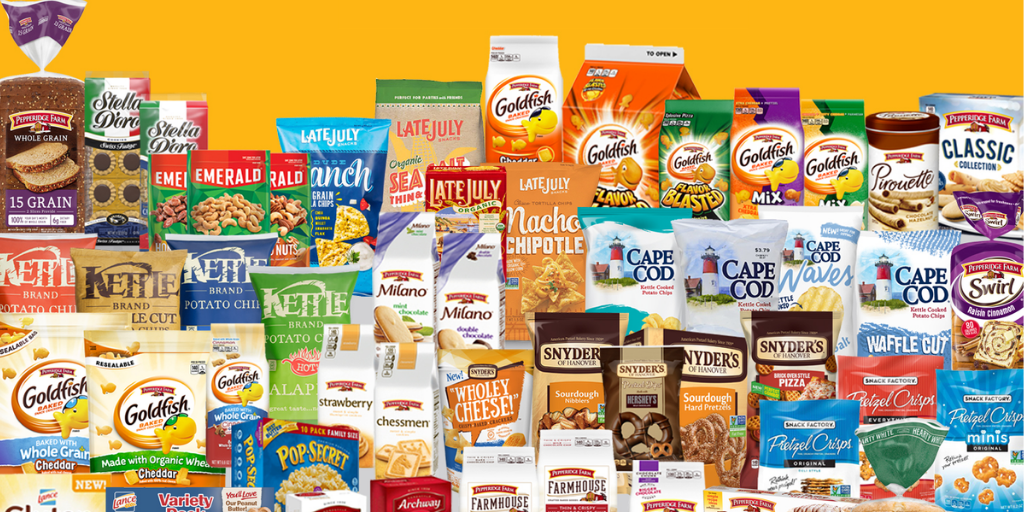
The Campbell’s Company snack portfolio.
P2PI always stresses that its Hall of Fame doesn’t recognize executives ready to be “put out to pasture” in retirement. As you look forward in your career, are there any predictions you’re comfortable making about the future of commerce? What are you most excited about in terms of the next 3-5-10 years?
Chriss: It’s scary to predict 3-5-10 years out because 3-5-10 weeks out is the question we’re asking today. I think we’re living in the future already. I often say we are writing history right now — we’re not waiting for the years to pass.
The things that we’re seeing right now — AI, digital-first mindsets, advanced analytics, continuous learning loops — that’s the history of today and the future. Those areas are going to advance extremely fast. It’s obvious that AI is leading the way, and we are just scratching the surface of what it’s going to do.
I don’t think we will ever lose the strategic mindset of humans and their ability to direct AI. It’s a learning loop of intelligence: we as humans are continuously learning from the technology, and the technology is learning from us. The more I put into a prompt, the more AI learns about me, gets smarter and begins to think for me — good or bad.
Is there another AI “thing” out there? I don’t know. Today, agentic commerce is it. But was that even in the conversation six months or a year ago? AI is here to stay, and whether it’s called “agentic” or something else, the concept of robotic learning or tech learning is the future.
Speed and convenience continue to be an underlying demand, too. I was in Seattle a couple weeks ago with a dot-com company headquartered there that was talking about 10-minute delivery — that is advanced analytics. Quick commerce is here and it’s going to collide with agentic commerce and the ability of agents to make decisions for us.
As I said, our core needs as shoppers aren’t changing. What has changed is this: I realized when I was on the airplane today that I needed protein powder and could order it from seat 23D to have it ready when I get back home to New Jersey on Thursday. That’s what I mean about living in the future, today.