
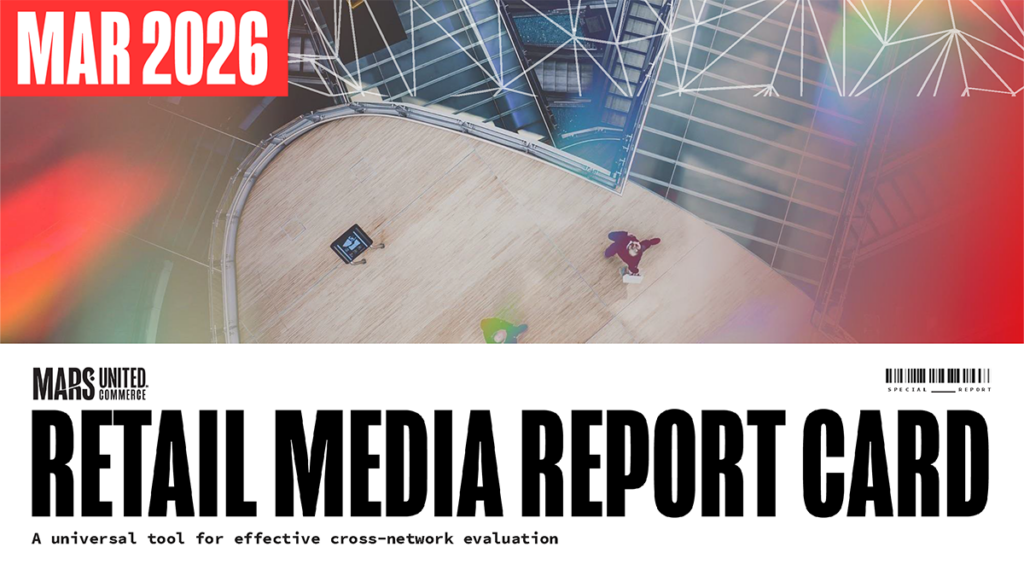
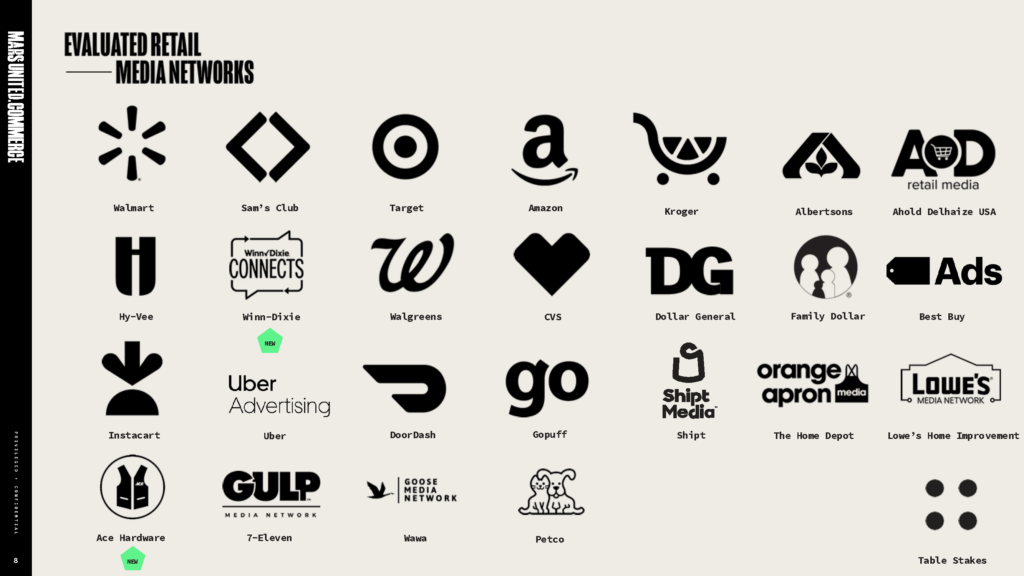
The 13th edition of the industry’s most informative cross-network assessment guide evaluates 90 capabilities at 25 leading platforms.
To download the report, fill out the form below.
U.S. advertisers are expected to spend $71.1 billion on retail media in 2026, a 20.9% increase over 2025, according to the latest EMARKETER forecasts. Not bad for a marketplace whose growth is supposed to be slowing.
Competition is intensifying, however, and not just within the still-swelling ranks of retail media networks: brand advertiser attention is captured not only by “commerce media” networks in travel, financial services, hospitality, and other service industries but soon by third-party agentic search platforms — now that tests at ChatGPT, Google, and elsewhere have ushered in the age of agentic advertising.
 That escalating competition, however, is driving ingenuity and innovation in the marketplace, as old-school retail networks strive to build unique platforms and processes that make it easier — as in directly, via self-service tools — for brand partners to achieve their specific business goals by providing access to identified audiences across the entire path to purchase.
Networks are working more closely with brands, following the requests and recommendations of advertising partners to earn their investments by enhancing and expanding opportunities and capabilities onsite, offsite, and in stores — the last of which still accounts for the vast majority of product sales, which are being conducted by a highly motivated, captive audience that non-retailer competitors are unable to deliver.
They’re also strengthening measurement capabilities by clearly proving performance through metrics that go behind traditional KPIs to satisfy the needs of the entire brand organization — not just the media planners. These efforts are all fully evident in the capability updates chronicled throughout this Report Card (starting on page 6).
These advancements are making it even more critical for brand advertisers to scrutinize their options carefully. Brands are tasked with developing a strategic understanding of how best to leverage retail media to drive incremental growth, deciding which retailers will provide the greatest opportunities for success, and determining what specific types of media investments will be most effective at achieving the desired impact.
They also must align their retail media activity with the rest of the commerce marketing plan, which can improve success not only through more seamless shopper engagement but by fostering greater internal efficiency across functions. This level of understanding is critical to future growth — not only for brands, but for retail media networks as well.
How to Pick Partners
There are two very important ways to evaluate the best retail media platforms for investment. The first is to assess each network individually, the role it plays within — and the impact it has on — your broader retailer relationship, and the opportunities it provides for achieving your specific brand objectives. Retail media has become a critical aspect of the broader supplier-retailer partnership and, in an increasing number of cases, an important factor in joint business planning. This broader context must always be considered when making investment decisions.
The second, more objective way to evaluate the best places to invest is by comparing the various networks to determine their relative strengths and weaknesses against a uniform set of key performance criteria. As the marketplace has evolved, in fact, a growing number of criteria that initially served as network differentiators are now “Table Stakes” that any network must offer to address the needs of brand partners and keep pace with competitors.
To help our clients efficiently evaluate spending opportunities, Mars United created a retail media health scorecard to track the capabilities of leading networks across the key criteria advertisers need to optimally plan, execute, and measure their activity. This general framework for network scorecarding is customized for each client to reflect its unique business objectives, budget, performance expectations, and retail partnership priorities. Internally, we continuously update the information to stay ahead of the rapidly evolving capabilities of existing networks and the ongoing launch of new platforms.
To help the industry at large gain a better understanding of the opportunities available, and to encourage the development of evaluation standards that might ultimately improve both the collaborative process and overall network effectiveness, Mars United has publicly shared this Retail Media Report Card on a quarterly basis since fall 2022. This public report presents the foundational scorecarding elements of our evaluation process for clients.
New Features This Quarter
We update each quarterly Report Card to reflect the ongoing enhancements made by these platforms, to evaluate additional platforms, and to modify our analysis as needed to continue reflecting best practices in the industry. For that reason, we have updated our Platform Profiles to more clearly and explicitly present each network’s key capabilities and ways of working. See page 24 for a rundown of all the new elements.
We also welcome Ace Hardware’s RedVest Media and Winn-Dixie’s WD Connects to our coverage this edition (although Meijer Media and Wakefern Media Exchange chose not to participate this round). And we’ve added Reddit to the list of Digital Off-Platform media partners with which networks are collaborating to extend their audiences for brand partners.
In terms of capability updates, 21 of the 23 retail media networks covered in our previous Report Card added a collective 67 tools and opportunities to their existing capabilities, working either to keep pace or gain an advantage (as the case may be) in this highly competitive marketplace. Dollar General Media Network led the pack with eight updates, followed by Shipt Media with seven and Ahold Delhaize Retail Media with five.
Nearly one-third of the updates were related to Measurement & Reporting as networks continue working to deliver stronger and more varied evidence of real business impact (True Incrementality, % New Buyers, Rest of Market Analysis) and additional self-service options for brand partners seeking easier, timelier, and deeper access to the data.
We hope you enjoy the 13th edition of our Retail Media Report Card. If you’d like to learn more about how Mars United can help you help excel in retail media, contact Willy Blesener at [email protected].